Make ten with your hands: the one number idea that unlocks addition
The pairs that make ten sit behind every sum in Class 1 and 2. How to teach them with ten fingers, a tray and a bowl of chana, ten minutes a day.
· 5 min read
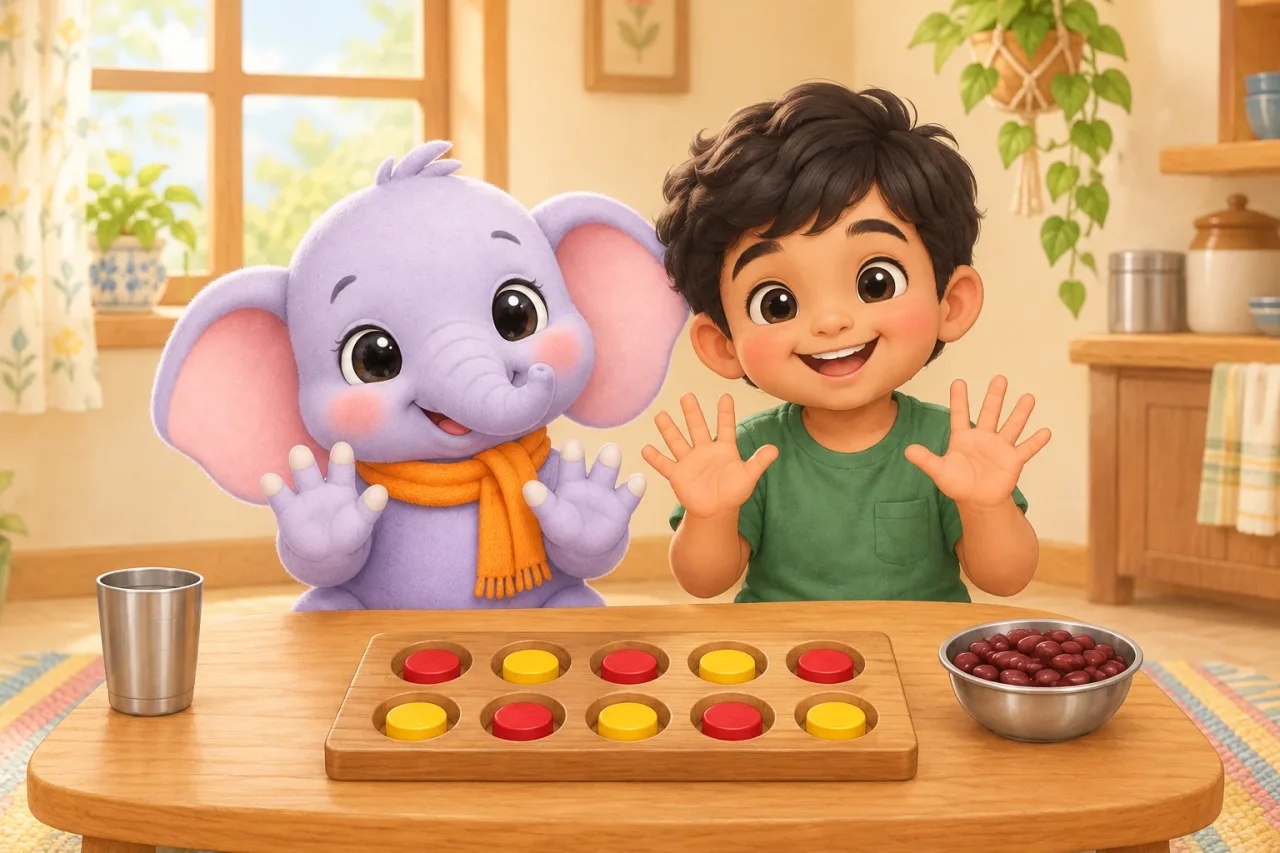
Ask a six-year-old what 8 + 5 is and watch their fingers. Most children count on from eight: nine, ten, eleven, twelve, thirteen. It works, slowly, until the numbers get bigger and the fingers run out.
Children who find addition easy do something different. They see 8 + 5 as “8 and 2 make 10, and 3 more is 13”. They are not faster at counting. They know the pairs that make ten so well that ten is a place they can always get to.
This guide shows you how to build that knowledge at home with the ten things every child carries around: their fingers.
Why ten is the number that matters
Our whole number system is built on ten. Thirteen is ten and three. Forty-seven is four tens and seven. A child who can make ten from any number without thinking has a handle on every number that follows.
The pairs that make ten are few: 1 and 9, 2 and 8, 3 and 7, 4 and 6, 5 and 5. Five pairs, and a child who knows them cold has learned most of what Class 1 and 2 addition will ask.
Knowing them “cold” means answering without counting. That is the goal of this routine, and it takes weeks of short, cheerful practice, not one long evening.
Start with the hands
Two hands, ten fingers, and the two halves are already in place.
Hold up all ten fingers. Fold two down. “How many are up? How many are hiding?” Eight up, two hiding, eight and two make ten. Do it for every pair. Let your child hold up the fingers and you say the hiding number, then swap.
Fingers are better than cards here because they are always there, there are exactly ten of them, and they come in two fives, so your child starts to see seven as five and two without counting.
Make a ten-frame from what is in the kitchen
A ten-frame is two rows of five squares. Draw one on a sheet of paper with a ruler, or use an ice-cube tray with ten cups, or ten katoris on a tray. For counters, a bowl of chana, rajma or buttons.
Put seven counters in. The top row fills up; two go into the bottom row. “How many empty squares?” Three. Seven and three make ten. The frame does the work: your child can see the gap instead of counting to find it.
Rules that keep the frame honest: fill the top row first, always left to right; say the number, say the gap, say the pair (“seven, three, seven and three make ten”); never let the frame hold more than ten.
The ten-minute routine
- Finger flash (two minutes). Show a number of fingers for one second, then hide them. “How many did you see?” Start with numbers up to five, then go beyond.
- Make ten on the frame (three minutes). You put in a number, your child fills the gap and says the pair. Five goes, then let them choose the number.
- Say the partner (three minutes). You say a number, your child says the partner that makes ten. “Six!” “Four!” As quick as you can, like a clapping game.
- One real sum (two minutes). Pose 8 + 5 with counters. Ask “How many to get to ten? Then how many are left?” Let them move two counters across and see 10 and 3.
Same order every day; new partners every few days; back to the hands whenever it wobbles.
Games that fit a bus ride
- Partner clap. You clap a number, your child claps the partner that makes ten.
- Shopping for ten. “I have ₹10. The toffee is ₹4. What is left?” Later, let them run the shop.
- Dominoes to ten. Pick any domino and ask how many more dots would make ten.
- Ten in the car. Count red cars; when you reach a number, your child says the partner.
- The hiding game. Ten chana under a dupatta; you take some away and show them; your child says how many are still hiding.
Mistakes worth avoiding
- Counting from one every time. If your child counts “one, two, three…” to check eight and two, go back to the frame so they can see the pair instead.
- Symbols too early. “8 + 2 = 10” is a way of writing something the child already knows. Say it in words first, write it later.
- Timing them. A clock turns a game into a test. Go faster only when your child wants to.
- Skipping five. The pairs that make five (1 and 4, 2 and 3) are the warm-up for ten. For a five-year-old, spend the first weeks there.
- Moving on too soon. “Knows it” means instant, in any order, on a sleepy evening. Keep the game going a week longer than you think you need to.
A checklist for the fortnight
- Ten fingers up, some folded down, say the pair: every day
- A ten-frame on paper or a tray, with a bowl of counters, where it can stay out
- Top row first, left to right, never more than ten
- Partners to five before partners to ten
- Words before symbols
- One real sum a day, solved by making ten first
- Praise the strategy: “You made ten first!”
Once ten is a place your child can always reach, the teen numbers stop being a mystery: thirteen is simply ten and three on the frame, one full row and three more. Doubles come next (6 + 6), then near doubles (6 + 7), then two-digit numbers, where the same trick, make a ten, becomes “carrying” in school.
None of this needs a worksheet. It needs ten fingers, a bowl of chana and ten minutes you were going to spend waiting for the dal anyway.
Try it in TypeMasti
In the Numbers world, the unit called Make 10 begins with The ten-frame, then Make 5, Make 10 and Doubles. Masti fills the frame with counters your child can tap, asks “2 and what make 5?” on a number bond, and only after that shows the digits. It is the same frame, the same pairs and the same order as this guide; Masti just says every line aloud.