Letter sounds before letter names: a ten-minute routine for four-year-olds
Why a four-year-old needs the sound of S before the name of S, which sounds to start with, and a ten-minute routine that fits before school or bath time.
· 5 min read
Most of us learned the alphabet as a song: ay, bee, see, dee. The names are fine for singing. But a child who is trying to read the word cat has no use for “see-ay-tee”. What helps is the sound each letter makes: c, a, t. Said quickly, one after the other, those three sounds are the word.
This guide is for a child of about four who is not reading yet. It explains why the sounds come first, which ones to start with, and a ten-minute routine you can run at the dining table, on the balcony or in the five minutes before bath time.
Why the sound comes first
A letter name is a label. A letter sound is a tool. When a four-year-old hears “sss” and sees the shape S, they are collecting a piece they will later push together with other pieces to make words. The name “ess” does not join on to anything.
The names can wait. Once a child knows eight or ten sounds and can hear a short word in its parts, the names arrive in a week or two, because they sit on top of sounds the child already owns.
Two small things trip up most homes. The first is saying “suh” instead of a clean “sss”: that extra “uh” turns cat into “cuh-a-tuh”, which no child can hear as a word. The second is starting with too many letters at once. One sound a day is plenty.
Which sounds to start with
Start with s, a, t, p. They are easy to say, easy to hear, and with just these four a child can hear sat, tap, pat and at. Then move to i, n, m, d, which open up sit, pin, man, dad and dozens more.
Say the short vowels the way they sound inside words: “a” as in apple, “i” as in ink. Not “ay”, not “eye”.
Keep b and d a few weeks apart so the shapes do not blur into each other. When you reach c and k, say plainly that they make the same sound; children accept this far more easily than adults expect.
The ten-minute routine
One sound a day, in the same order every day, so your child knows what is coming.
- Hear it (one minute). Say the sound three times with an action. “Sss, like a snake”, with a wiggle of the hand. Your child copies the sound and the action.
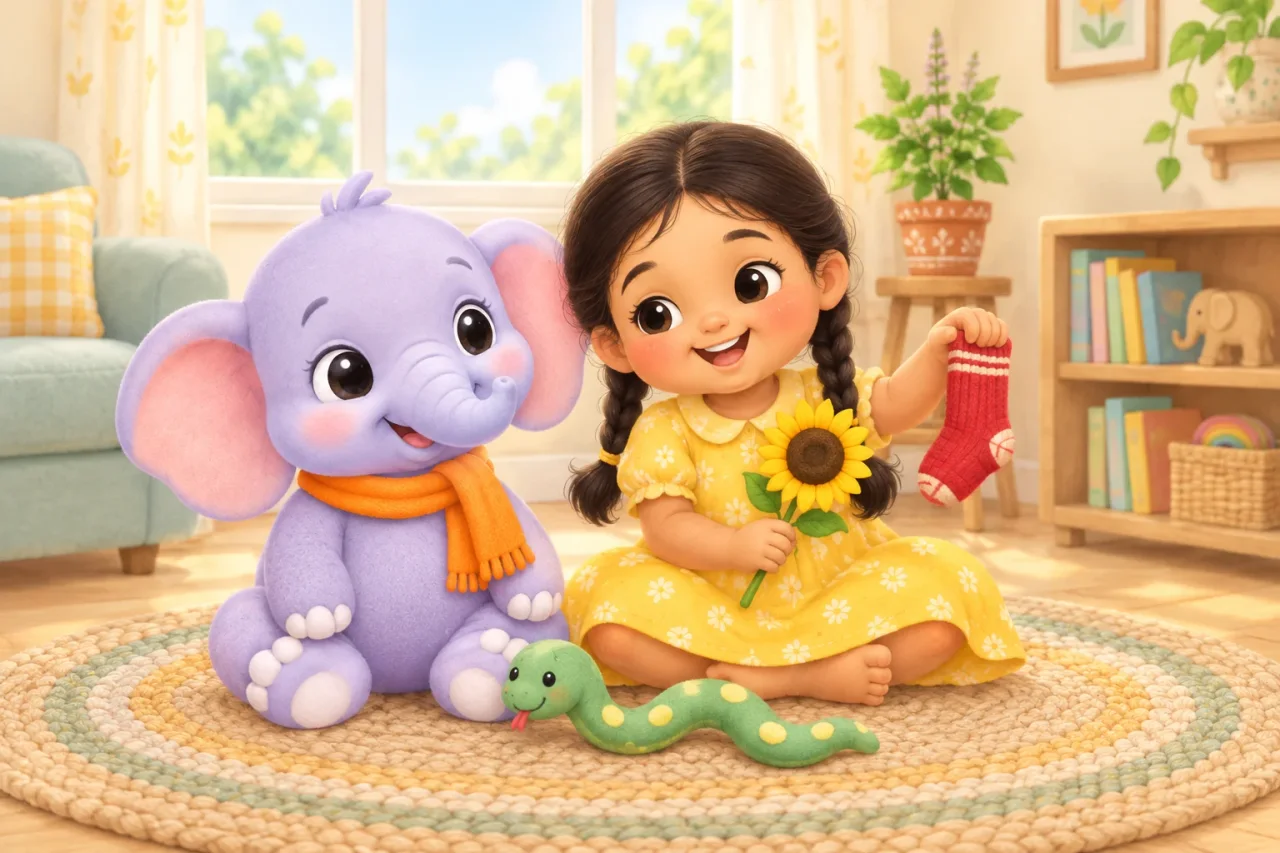
- Find it (three minutes). Fetch three or four things from the house that start with the sound: a sock, a spoon, a sunflower, a bar of soap. Say each name slowly, stretching the first sound: “sssock”. Let your child say it back.
- Spot the letter (three minutes). Write the letter big on a sheet of paper, small shape and capital, or point to it on a keyboard. “This says sss. Can you find it?” Hide it among two other letters and let them point.
- Say it back (two minutes). Now swap: you point to the letter, your child says the sound. Then point to a thing, and they tell you its first sound.
- Stop (one minute). Finish while it is still fun. Say what they did: “You found S three times!” Tomorrow is another sound.
Games for the kitchen, the bus and the queue
- I spy, with sounds. “I spy something that starts with mmm.” A mango, a mug, Mummy.
- Sound hunt. On a walk, find three things that start with today’s sound. A dog, a door, a dustbin.
- Robot talk. Say a word slowly in its parts, “c… a… t”, and let your child guess the word. Then let them be the robot.
- Silly soup. “I am making sss soup. What goes in?” Sock, samosa, sun, snake. Wrong answers are funny, not wrong.
- Tap the first sound. Say a word and let your child tap the table once for its first sound and say it.
Mistakes worth avoiding
- Adding “uh”. Practise the pure sounds yourself first: sss, mmm, nnn, fff, and a short, quiet “t”, “p” and “k”.
- Testing before teaching. Say the sound before you ask for it. “This is sss. Which one is sss?” is kind; “What does this say?” on day one is a quiz.
- Capitals only. Children see small letters far more often in books, so show the small shape first and the capital beside it.
- Rushing to writing. Writing letters needs finger control that comes later. Pointing, tapping and finding are enough at four.
- Correcting hard. If your child says “mmm” for N, simply say “That one is nnn. Nnn, like a nose,” and move on. No sighs, no “no”.
A checklist for the week
- One sound a day: s, a, t, p first, then i, n, m, d
- Clean sounds: “sss”, not “suh”
- Ten minutes, at the same time each day
- Three or four real things from the house for each sound
- Say the sound before you ask for it
- Praise the exact win: “You found S!”, not “Good job”
- Stop while it is still fun
When to bring in the letter names
When your child can hear a sound and pick the right letter for six or eight letters, start naming them, one or two at a time, always alongside the sound: “This is S. It says sss.” Sing the alphabet song as a song; it is a good way to learn the order, and the order matters later for dictionaries and the keyboard.
By then you will notice something else: your child starts hearing the first sound of words on their own. “Mango starts with mmm!” That is the moment reading begins, and it begins with the ear.
Try it in TypeMasti
The Letters & Words world opens with a unit called Letter sounds, and its first lesson is A, B, C. Masti says the sound, your child finds the letter on the on-screen keyboard, and only then does a picture word appear. For a child in the Explorer band (ages 3 to 5), every prompt is spoken and the child taps or presses a single letter; nothing has to be read. It is the routine above, with a lavender elephant doing the saying.