He, she, it, they: first sentences at home with a six-year-old
He, she, it and they with is and are: simple games with family photos, the dinner table and the pets outside, and a kind way through the he/she mix-up.
· 6 min read
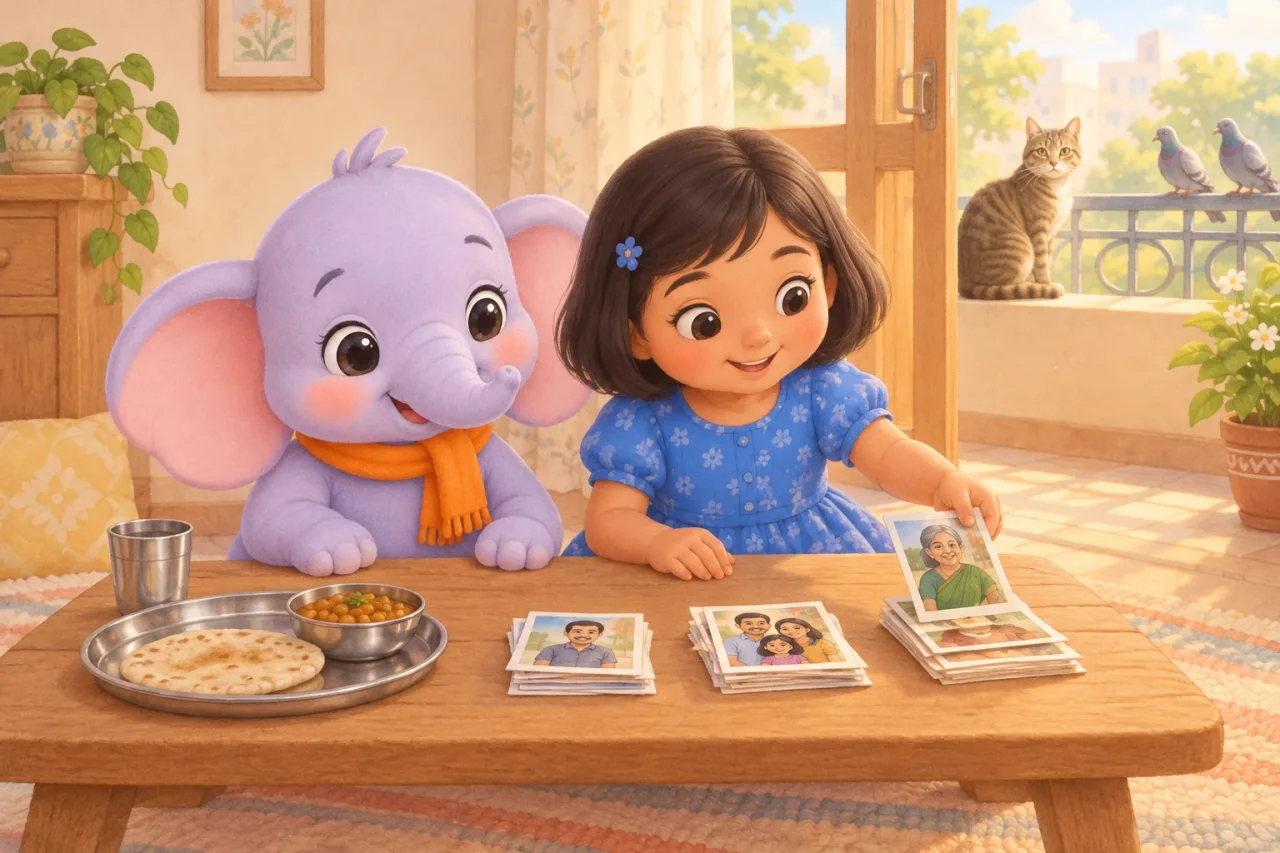
Show a six-year-old a photo of Nani and ask what she is doing. Many children in Indian homes will happily answer, “He is cooking.”
Nothing is wrong with their eyes or their understanding. They are carrying a habit over from the language they speak at home, and it is one of the easiest habits to change with a little play.
The Class 1 English chapter on pronouns asks for four small words, he, she, it and they, plus the little verbs that go with them: is, am and are. This guide gives you what to say, a ten-minute routine, and games that use family photos, the dinner table and the pets outside.
What the Class 1 chapter asks for
A pronoun is a word that stands in for a name, so we do not have to say “Riya” in every sentence. In Class 1, children meet a small set:
- he for one boy or man: Papa, Dada, the bus uncle
- she for one girl or woman: Mummy, Nani, the class teacher
- it for one animal or thing: the cat, the ball, the roti
- they for more than one: two dogs, Mummy and Papa, the plates
Most books also bring in I, we and you, with the verb that fits: I am, he is, she is, it is, we are, you are, they are.
Give your child the idea in one line: “He, she and it are for one. ‘They’ is for many.” Then the verb follows the same rule: one takes is, many take are, and I always takes am.
One small wrinkle. At home your dog Bruno may be “he”, and that is perfectly good English. The textbook uses “it” for animals to keep the rule simple, so tell your child that both are fine, and that on the worksheet an animal is “it”.
Why he and she get mixed up in Hindi-speaking homes
In Hindi, one word, वह, does the job of he, she and it. “वह खेल रहा है” and “वह खेल रही है” use the same वह; whether it is a boy or a girl shows up in the verb, not in the pronoun.
So a child thinking in Hindi reaches for one English word and grabs whichever comes first, usually “he”. This is a sensible mistake, not a careless one. Your child has learned that one word is enough for everybody, and English now asks them to split it into two.
It can help to point at the clue Hindi already gives. Say it once, lightly: “In Hindi you say khaati for Nani. In English, Nani gets she.” If your home language is another one, the routine below works just the same.
The ten-minute routine
Do it at the same time each day, in the same order, so your child knows what comes next.
- Who is that? (two minutes). Point at people and things in the room and say the name, then the word: “Papa. He.” “Didi. She.” “The fan. It.” Your child copies, then you swap and they do the pointing.
- Sort the photos (three minutes). Spread six or eight family photos on the bed, printed or on the phone. Make three piles: he, she and they. Your child places each photo and says the word aloud as it goes down.
- Swap the name (three minutes). Pick a photo and say a sentence with a name: “Nani is at the temple.” Your child says it again with the pronoun: “She is at the temple.” Four or five photos is enough.
- One is, many are (one minute). Hold up one spoon: “It is a spoon.” Hold up three: “They are spoons.” Let your child do the next two things themselves.
- Stop on a win (one minute). Name exactly what they did: “You said she for Nani every single time!”
Change the photos every few days. Keep the order.
Games with photos, the dinner table and the pets outside
- Dinner-table sentences. Your child points at one thing and makes a sentence: “It is a roti.” “It is hot.” Then at many: “They are chana.” “They are cups.”
- Balcony watch. A crow on the wire: “It is black.” Two pigeons on the railing: “They are grey.” The neighbour’s cat in the sun: “It is sleeping.”
- Who am I thinking of? You say, “She has a red dupatta. She is in the kitchen.” Your child guesses who. Then they give you the clues.
- School bus spotting. “He is the driver.” “She is the aunty.” “They are going to school.”
- Catch me out. Say the wrong word on purpose: “Look, she is Dada!” Let your child catch you and fix it. Children love correcting a grown-up, and they have to think about the rule to do it.
What to say when it comes out wrong
- Say it back the right way. If your child says “He is cooking” about Nani, answer, “Yes, she is cooking. Nani is making dal.” Lean a little on “she” and carry on talking.
- Give a clue, not a verdict. “Is Nani a he or a she?” lets your child fix it themselves, which sticks far better than being told.
- Keep it private. Never laugh at the mix-up in front of cousins or guests. A child who feels silly stops trying.
- One thing at a time. If he and she are wobbling, leave is and are for another day.
- Keep the home language. Hindi at home is a strength, not a problem. English is simply a second set of words for the same people.
- Say before you write. Read a worksheet aloud with your child before they fill a blank. Spoken first, written later.
A checklist for the week
- Ten minutes a day, same time, same order
- Six to eight family photos sorted into he, she and they piles
- One “it” sentence and one “they” sentence at every dinner
- “It” for animals on the worksheet; “he” or “she” for your own pet is fine
- I am; he, she and it is; we, you and they are
- Say it back the right way instead of saying “wrong”
- Praise the exact win: “You said she for Mummy!”
When the piles come out right without a pause, move to two-sentence stories: “This is Meera. She is my sister.” Then let your child make up a sentence about each person at the dinner table. That is a first spoken paragraph, and it began with a pile of family photos.
Try it in TypeMasti
The Letters & Words world has a new unit called He, she, it, they. Masti shows a picture, reads the sentence aloud with a gap in it, and your child picks he, she, it or they and types the word in. Every prompt is spoken, so the only reading your child does is the short word they are choosing.
For animals, the lesson Farm friends in the My World unit Animals makes a good partner. As each farm animal appears on the screen, your child names it, and you ask for one sentence aloud: “It is a cow.” When two appear, it becomes “They are cows.”