Before the alphabet: five listening games for a three-year-old
Rhyme, clapping beats and first sounds come before any letter shape. Five listening games for a three-year-old, with a steel tumbler and a bowl of chana.
· 6 min read
Long before a child can tell M from W, they can hear that cat and hat sound alike. They can hear that banana has more parts than bun, and that mango and milk begin the same way. That is listening, and later reading grows out of it.
This guide is for a child of about three who cannot read yet and does not need to. It has five short games, a ten-minute routine and a few things to avoid. You need your voice, your hands and a few things from the kitchen.
Why the ear comes before the letters
A letter is a picture of a sound. If a child cannot yet hear the sounds inside a word, the picture has nothing to stick to. So the ear comes first, and the letter shapes can wait.
There are three things to listen for, in this order. Rhyme: words that end the same, like sun and bun. Beats: the parts of a word you can clap, like ro-ti, and first sounds: the “mmm” at the start of milk.
None of this needs a book, a slate or a pencil. It fits in while you cook, walk to the gate or wait for an older sibling’s school bus.
Rhyme games: the end that sounds the same
Game 1: Rhyme or not? Say two words and ask, “Same at the end?” Your child gives a thumbs up or a thumbs down.
Start with easy pairs: cat, hat; sun, bun; pen, hen; log, dog. Then slip in a pair that does not rhyme, like cat, bus, and see if the thumb goes down.
If your child says yes to everything, that is fine at the start. Say both words again slowly, stretching the end, “c-at, h-at, same!”, and carry on.
Game 2: Finish the line. Say a short rhyming line and stop before the last word: “I see a cat, sitting on a…” Your child shouts “mat!”, and any rhyming word counts, even a silly one like “zat”.
Nursery rhymes work the same way. Sing “Twinkle, twinkle, little…” and wait for the missing word. Rhymes in Hindi, Marathi, Tamil or whatever you speak at home are just as good.
Clapping games: the beats in a word
Teachers call these beats syllables, but you do not need the word. A beat is simply a part of a word you can clap.
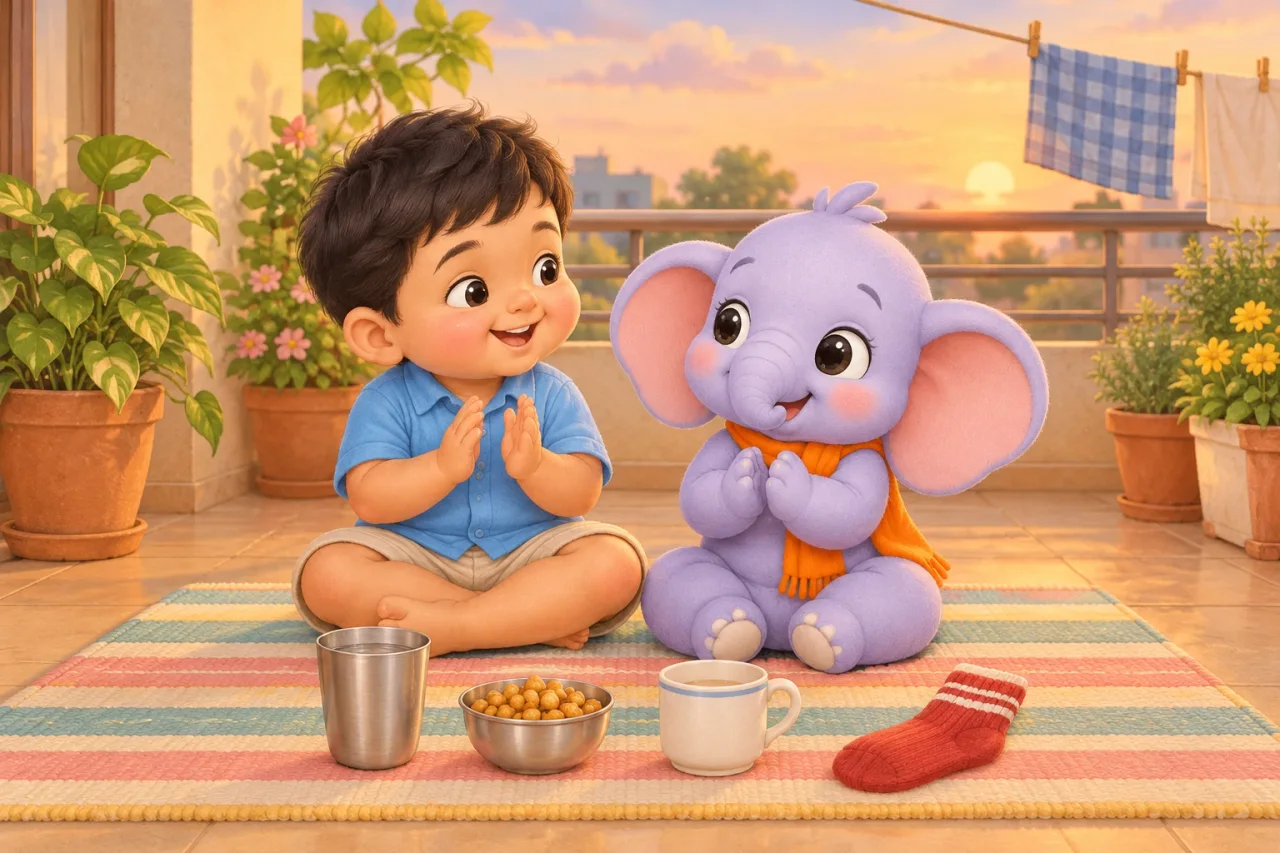
Game 3: Chana in the tumbler. Put a steel tumbler and a small bowl of chana on the table. Say a word slowly in its beats, ba-na-na, and let your child drop one chana into the tumbler for each beat. Every chana goes “ting”, which is half the fun.
Start with names, because children love their own. Ri-ya is two chana, Ar-jun is two, Dad is one, Ma-sti is two. Then move to food: roti, dal, rice, mango, banana.
When the tumbler is not handy, just clap: one clap for cat, two for ro-ti, three for ba-na-na. Then ask, “Which has more claps, bun or banana?”
First-sound games: how a word begins
This is the hardest of the three, so keep it short. Always say the sound before you ask for it.
Game 4: Which one starts with mmm? Put three things in front of your child: a mug, a key and a sock. Name each one slowly, “mmmug, key, sssock”, then ask, “Which one starts with mmm?” Let them point or pick it up.
Use sounds you can stretch: mmm, sss, fff, nnn. A long “sss” is easy to hear; a short “t” or “p” is not, so save those for later. Swap the things around and play again.
Game 5: Guess the stretch. Start a word with a long first sound and let your child guess the rest. Try “mmmmm, someone in this house” and wait for “Mummy!”, or “sssss, something on your feet” for socks.
This one needs nothing at all, so it is the game for the auto, the clinic queue or the walk home. Once your child is good at guessing, let them stretch a word for you.
A ten-minute routine
Ten minutes once a day, at the same time, is plenty. Before bath, after the evening snack or while the cooker whistles all work.
- Rhyme warm-up (two minutes). Five pairs of Rhyme or not, then one line of Finish the line.
- Beats (three minutes). Chana in the tumbler with four or five words, family names first.
- First sounds (three minutes). One sound for the whole day, and three rounds of Which one starts with it, using things from the house.
- Guess the stretch (one minute). Two or three words with today’s sound.
- Stop (one minute). Say what they did: “You heard that sun and bun rhyme!” Put the tumbler away while they still want more.
On a busy day, play just one game. One game in the auto is better than a skipped week.
Mistakes worth avoiding
- Showing letters too soon. These games are for the ear. Leave the alphabet chart on the wall and look at each other instead.
- Saying “suh” for s. Keep sounds clean: “sss”, “mmm”, “fff”. An extra “uh” makes the first sound harder to hear.
- Asking without showing. Play the first round yourself, out loud, so your child hears what an answer sounds like.
- Correcting hard. If your child says cat rhymes with dog, say “Cat, hat sound the same. Cat, dog do not,” and move on. No sighs, no “wrong”.
- Going too long. Stop before your child gets restless. Five cheerful minutes beat fifteen tired ones.
- Too many sounds at once. One first sound a day, or one for the whole week if it feels shaky.
A checklist for the week
- Rhyme pairs every day, with thumbs up or down
- One nursery rhyme with the last word left for your child
- A steel tumbler and a bowl of chana for counting beats
- Family names clapped first, then foods
- One first sound a day, stretched long: mmm, sss, fff, nnn
- Say the sound before you ask for it
- Praise what they heard: “You heard the mmm!”
- Ten minutes at most, and stop while it is fun
When your child can hear most rhymes, clap two- and three-beat words and pick the “mmm” thing out of three, they are ready to meet the shape that goes with a sound. Take it one sound at a time: “This shape says sss.” Our guide to letter sounds before letter names has a routine for that next step.
Try it in TypeMasti
In the Letters & Words world, the Explorer band (ages 3 to 5) has a unit called First sounds: s, a, t, p, and it opens with S says sss. Masti says “sss” slowly and asks which picture starts with it; your child taps the picture and presses one key.
Every prompt is spoken aloud, so nothing has to be read. Play the games above for a week first, and the lesson will feel like one more round of Which one starts with it.