Space at home: sun, moon, stars and a cardboard rocket
What a six-year-old can learn about space just by looking up, and four ten-minute things to do at home: a moon diary, star counting and a cardboard rocket.
· 6 min read
Ask a six-year-old where the sun goes at night and you will get a wonderful answer. Maybe it sleeps behind the building, or goes to Nani’s house. These answers come from a child who is already watching the sky.
Space is a big subject, but a child of five to seven does not need rockets and telescopes to start. They need to look up, at the same time every day, with a grown-up who asks good questions. This guide gives you what to say, what to do with things from the house, and a routine that fits into ten minutes.
What your child can see for themselves
By day there is the sun. By night there is the moon, the stars and sometimes a very bright dot that does not twinkle. That is nearly all of space a child can see without help, and it is plenty.
Start with three plain facts. The sun is a star, the closest one to us, which is why it looks so big and feels so hot. The stars at night are suns too, only very, very far away.
A planet is a big round world that goes round the sun. We live on one, and it is called Earth. If your child spots a bright point that shines steadily instead of twinkling, it is often a planet, and that is a thrilling thing to tell them.
One safety rule, said once and calmly: we never look straight at the sun, not even with sunglasses. Look at what the sun does instead. Its light makes shadows, and shadows are a daytime space game in themselves.
Why the moon changes shape
This is the question every child asks, and the answer is simple enough for a six-year-old. The moon does not make its own light. The sun shines on one half of it all the time.
The moon slowly goes round the Earth, about once a month. As it moves, we see more or less of its bright half. So the moon is not really changing; our view of it is.
Show it in a dark room. A torch on the table is the sun. Your child holds an orange at arm’s length and turns slowly on the spot, watching the orange.
They will see a thin sliver of light, then half, then a full bright face, then a sliver again. Let them do it three or four times. Then go to the window and find the real moon.
Indian homes already know this rhythm. Purnima is the full moon, amavasya is the night with no moon, and Diwali falls on a no-moon night. Eid begins when the thin new moon is spotted, and Karva Chauth ends when the moon is seen.
The ten-minute routine
Do one of these each evening, in turn, so the week has a pattern.
- The moon diary (three minutes). Tape a sheet with a grid of boxes to the fridge, one box a night. Your child looks out, finds the moon and draws its shape. Cloudy? Draw a cloud. Some mornings the moon is in the daytime sky, and that goes in too.
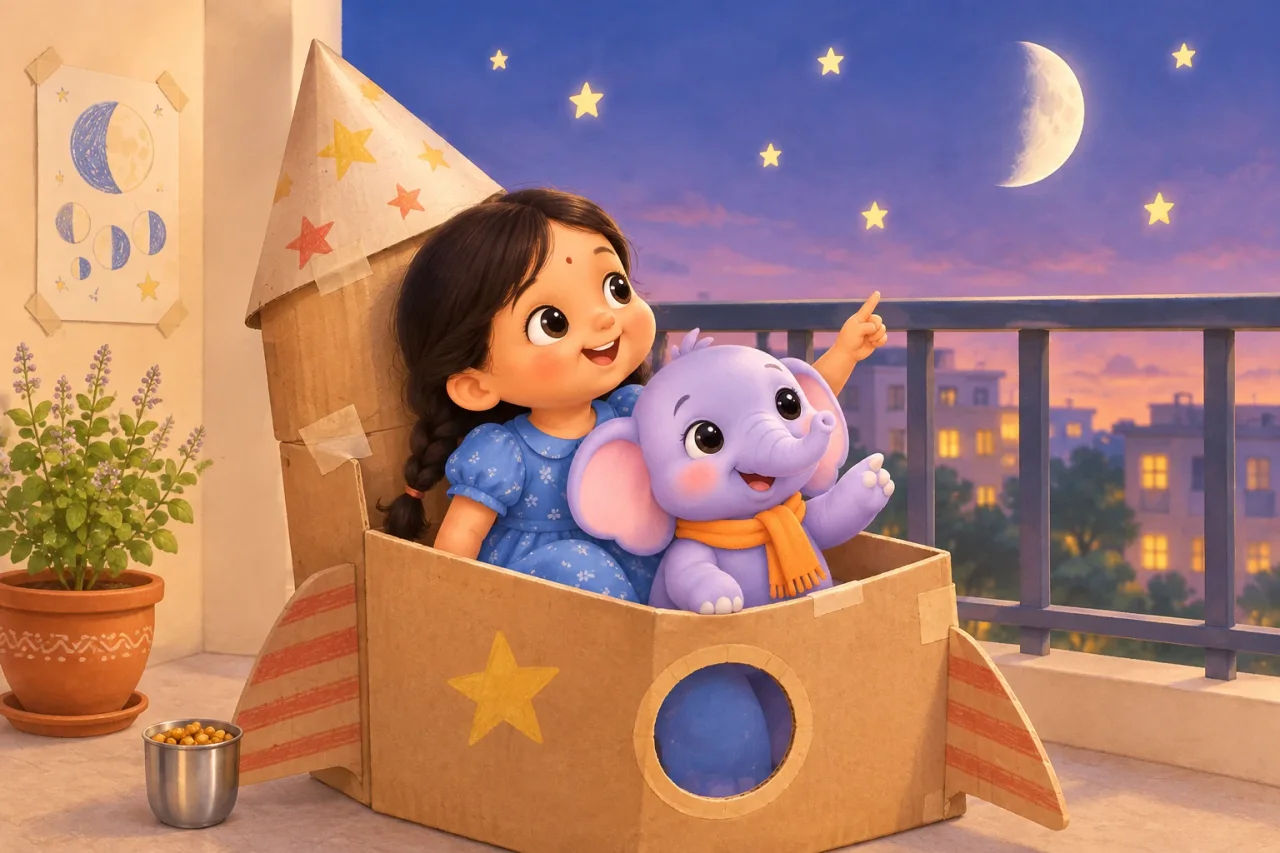
- Count the stars (five minutes). Stand on the balcony with a steel tumbler and a bowl of chana. Wait a minute for your eyes to settle, then drop one chana in the tumbler for each star you find. Tip them out and count together, up to 20.
- Shadow check (two minutes, by day). Stand your child in the same spot at breakfast and after school. Draw round their shadow with chalk. Morning shadows are long; midday shadows are short. Ask why.
In a city, you may find only a handful of stars. That is fine. Five stars counted carefully is a good night’s work.
A cardboard rocket with a countdown
Keep the next big delivery box. Cut a round window in one side, tape a paper cone on top, and let your child colour it however they like. A cushion inside makes it a cockpit.
Every launch needs a countdown. Counting backwards from 10 is harder than counting forwards, and a rocket makes it worth practising: “Ten, nine, eight…” all the way to “zero, blast off!”
When ten is easy, count down from 20. Then try skipping: “Twenty, eighteen, sixteen…” The rocket can fly to the moon, land, and report back on what it saw.
Four words on the keyboard
Space has four short words a child can type: sun, moon, star and sky. Do one a day on a laptop, a phone keyboard or a sheet of paper with letters drawn on it.
Say the word slowly in its sounds. “S… u… n. Find the s.” Your child finds each letter and presses it, one finger is fine.
Sun is the easiest, three sounds and three letters. Star starts with two sounds stuck together, s and t. Moon has two o’s side by side; let your child spot that. Sky ends in a y that sounds like “eye”, which is worth a giggle.
Mistakes worth avoiding
- Turning it into facts to memorise. A list of planet names means little at six. One thing seen with their own eyes means a lot.
- Correcting a lovely idea. “The moon is following our car!” is a sharp observation. Say, “It does look like that. It’s so far away that it seems to stay with us.”
- Staying out too late. Five minutes on the balcony before dinner is enough. Stars will be there tomorrow.
- Scary warnings. Say the sun rule once, plainly, and move on.
- Doing the diary for them. A wobbly moon drawn by your child is worth more than a neat one by you.
A checklist for the month
- A moon diary on the fridge, one drawing a night
- A steel tumbler and chana by the balcony door for star counting
- A torch and an orange for the moon-shape show
- One cardboard box, one paper cone, one countdown a day
- One space word a day typed: sun, moon, star, sky
- The sun rule said once: never look straight at it
- Ask “What did you see?” before you explain anything
By the end of a month your child will have a fridge sheet that shows the moon going from thin to full and back. They made that record themselves. That is what scientists do: they look, they write it down, and they look again.
Try it in TypeMasti
The My World world has a new unit, Up in space, with a picture book, Up, Up to the Moon, that follows a child and Masti on a rocket ride. Masti reads every page aloud, and your child answers short questions with words from the story. You will find it with the rest of the world at /modules/my-world/.
For the countdown, the Numbers unit Count to 10 has a lesson called 6, 7, 8, where Masti shows counters and your child taps to count them, then types the number. My World also opens with Farm friends, where your child hears an animal word, sees the picture and types it letter by letter, just as they typed sun, moon, star and sky with you.