India at home: the flag, the chakra and the national animals
What a Class 1 child is asked about India, from the flag's colours to the peacock and tiger, with ten-minute games to play at home.
· 6 min read
Around Independence Day and Republic Day, and often in between, a Class 1 child comes home with questions about India. Which colour goes on top of the flag? What is the wheel called? Which bird is ours, and which animal?
None of this needs a textbook. The flag, a peacock, a tiger and a mango are already in your home, in picture books, on the TV and on the dinner plate.
This guide is for a child of five to seven. It covers what the class will ask, how to say it simply, and a ten-minute routine with crayons, a book and your evening meal.
What Class 1 asks about India
The questions are short and they repeat every year. Your child will be asked about the national flag, its three colours in order, and the wheel in the middle.
Then come the national symbols: the bird, the animal, the flower, the fruit and the tree. The answers are the peacock, the tiger, the lotus, the mango and the banyan.
That is the whole list for now. Seven or eight facts, each one tied to something your child can see and point at.
The flag and its wheel
The flag is called the Tiranga, which means three colours. From top to bottom: saffron, white, green. Saffron looks like orange to most children, so say “saffron, the orange colour on top” until the word sticks.
Keep the meaning simple. Saffron for courage, white for peace and truth, green for growth and the land. One short line for each colour is enough at this age.
In the white stripe sits a navy blue wheel, the Ashoka Chakra. It has 24 spokes, the lines that run from the middle to the edge. That is past the numbers most Class 1 children are sure of, so count it together, and let your child say the last few numbers after you.
The bird, the animal and the rest
- National bird: the peacock. The one with the long, bright tail that it spreads like a fan.
- National animal: the tiger. Orange with black stripes, the big cat of the forest.
- National flower: the lotus. Pink, it grows in ponds and floats on the water.
- National fruit: the mango. The one your child probably asks for every summer.
- National tree: the banyan. A huge tree with roots that hang down from its branches like ropes.
Give one fact per symbol, never a paragraph. “The peacock is our national bird. It dances when it rains.” That is all a six-year-old needs to hold.
Why saying it while pointing works
A worksheet asks your child to match a word to a picture on paper, alone, in silence. Many children at this age can do that and still not remember it a week later.
When your child points at the real peacock in a book and says “peacock” out loud, they hear the word, see the thing and use their hand all at once. Then you say it back, and they hear it twice.
It also lets you catch mistakes the moment they happen. If your child points at green and says “top”, you can turn the paper round together right then, not mark it wrong the next morning.
The ten-minute routine
Same order every evening, one new thing a day, the old ones repeated.
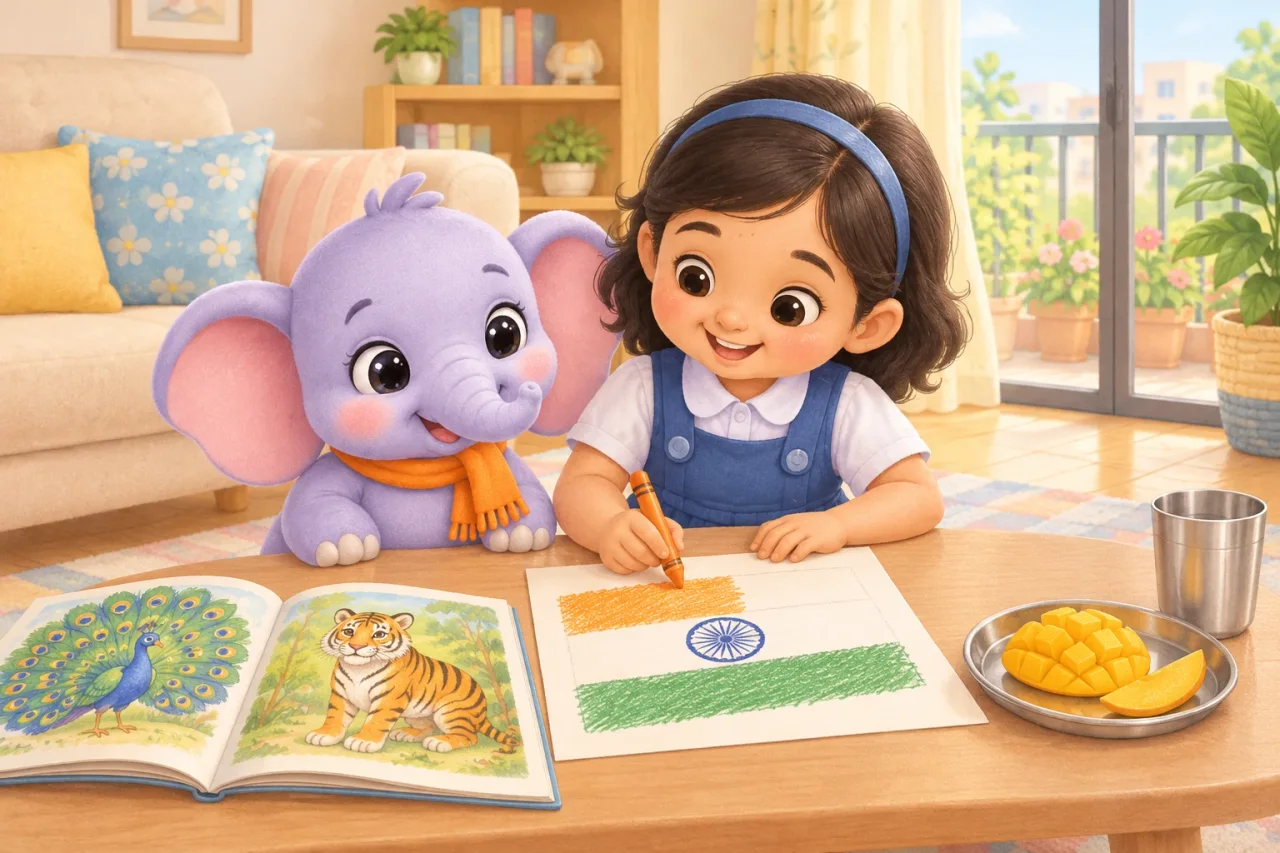
- Colour the flag (three minutes). Draw three wide stripes on a sheet of paper. Your child colours them, saying each colour aloud as they start: “Saffron on top. White in the middle. Green at the bottom.”
- Draw and count the wheel (two minutes). Draw a circle in the white stripe with a blue crayon. Add a few spokes together and count them, then tell your child the real wheel has 24.
- Find it in a book (three minutes). Open any picture book of animals. “Can you find the peacock? Point and say it.” Then the tiger, then the elephant for fun. One clue each: “Find the one with stripes.”
- Say it back (two minutes). Now swap. You point at the flag or a picture, your child says the word. Stop while they are still enjoying it.
On days without a book, use the newspaper, a calendar, a matchbox, or the stickers on a school notebook. Peacocks and tigers turn up everywhere once you start looking.
Games for dinner and the bus
- What is on my plate? At dinner, ask your child to name what they are eating: roti, dal, chana, rice. In summer, “Mango! Our national fruit.”
- Flag spotting. On the school bus or a walk, look for flags on buildings, autos and shop boards. “Which colour is on top?”
- Who am I? “I have a long tail and I dance in the rain.” Your child guesses the peacock, then gives you a clue.
- Tumbler drum. Tap a steel tumbler once for each colour of the flag while saying it: saffron, white, green.
- Lotus hunt. Look for lotus shapes on temple walls, rangoli, bedsheets and old coins.
Mistakes worth avoiding
- Green on top. It is the most common slip. Always start colouring and saying from the top, and if your child turns it round, say “Saffron goes up, like the sun” and fix it together.
- Too many facts at once. Seven symbols in one evening blur into each other. Add one a day and repeat the old ones.
- Asking before telling. “Which is the national bird?” on day one is a quiz. Say it first: “The peacock is our national bird. Can you find it?”
- Long explanations. The meaning of each colour fits in a few words. History of the flag can wait until your child asks.
- Only paper. A worksheet once a week is fine. The pointing, saying and finding is what does the work.
A checklist for the week
- Flag coloured from the top: saffron, white, green
- A blue wheel in the middle, with its name, Ashoka Chakra
- Spokes counted together, the number 24 said aloud
- Peacock and tiger found in a book, pointed at and named
- Lotus, mango and banyan added, one a day
- Dinner named aloud at least once
- Ask only after you have told
- Stop while it is still fun
By the end of the week, your child will likely be the one pointing out flags from the bus window and correcting you if you say “orange”. That is the moment to let them be the teacher for a day.
Try it in TypeMasti
In the My World world, the new unit India, my country brings the flag, its colours and the national symbols to the screen, with Masti saying every line aloud. To practise the animals first, open the lesson Wild animals in the Animals unit: Masti names an animal, your child finds its picture and types the word, so the tiger and its friends get pointed at, heard and said, just as in this guide. Find both in the My World world at /modules/my-world/.