Festival words at home: Diwali, Holi, Eid and Christmas
Diyas, gulal, sewai and kites: the words a five-year-old meets in the festival months, and ten-minute things to count, sort and name at home.
· 6 min read
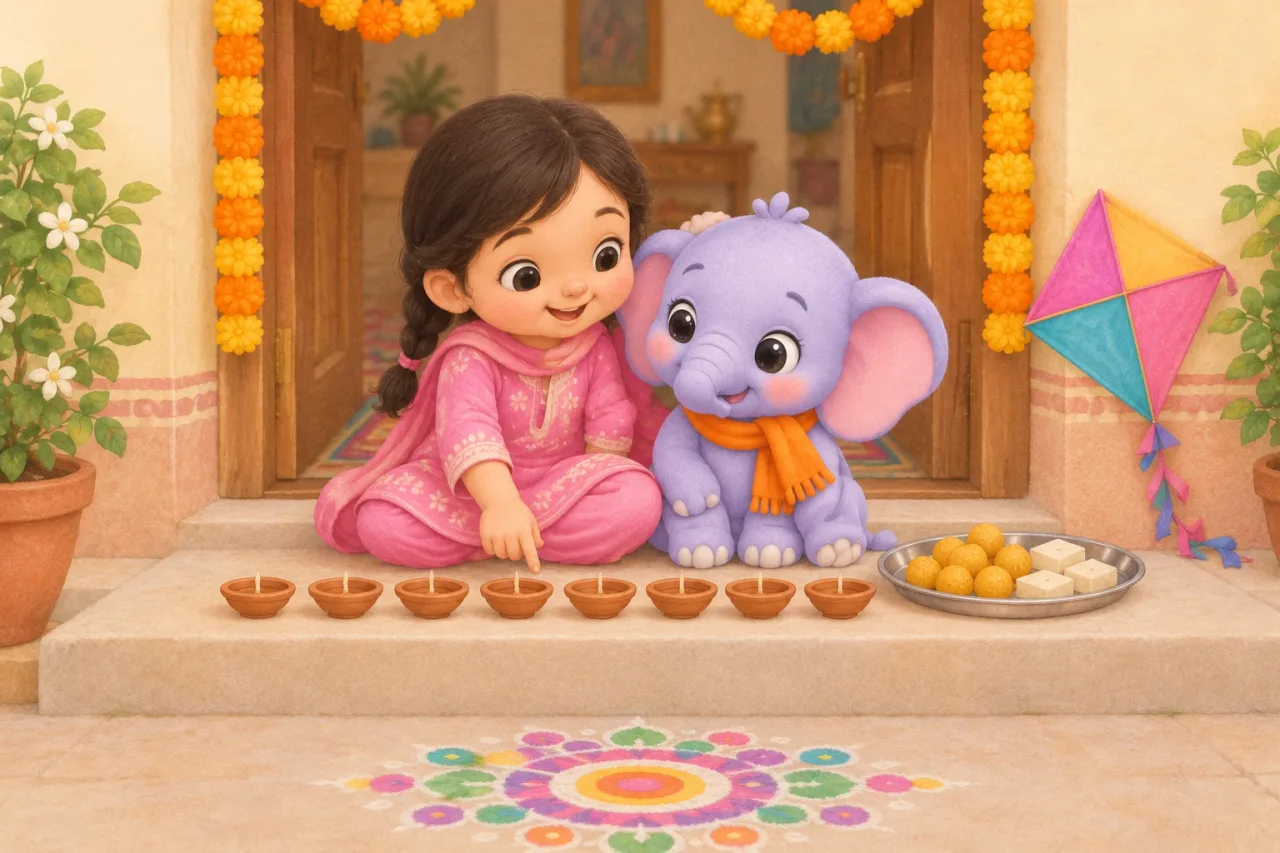
From rakhis in August to Christmas stars in December, and on to the kites of January, an Indian home is full of things worth naming. A five-year-old sees diyas on the step, a plate of sweets passed around, a drum in the lane and a string of marigolds over the door.
Each of those things is a word, and each word comes with something to count, sort or make. This guide gives you the words, a ten-minute routine and four small activities built on what is already in the house.
Every home celebrates differently. Everything here is about things a child sees and does, so the neighbour’s diyas or a school friend’s Eid sewai count just as much as your own.
Twelve words for the festival months
Here are the words, grouped by where your child is most likely to meet them. You do not need all of them; pick the ones your child will actually see this month.
- Raksha Bandhan: rakhi, gift
- Diwali: diya, rangoli, sweets, sparkler, garland
- Eid: sewai, gift
- Christmas: star, cake, gift
- Holi: gulal, pichkari, drum
- Makar Sankranti, Lohri, Pongal and Uttarayan: kite
Some words belong to many festivals. A drum turns up at weddings, processions and carols, and a gift turns up almost everywhere. Point that out: it helps a child see that a word is the same word wherever it appears.
Words to read, words to say
At five to seven, many children can sound out short words like drum, gift, kite, star and cake, and plenty already know diya from school. These are the words to write on a chit and read together.
Longer words such as rangoli, pichkari, sparkler and garland are words to say, not read. Point, say the word clearly, let your child say it back, and leave the spelling for later.
Once a word is familiar, put it in a short sentence such as “I see a diya” or “The kite is up”. Read it to your child first, then let them read it back with a finger under each word. Seven words is plenty at this age, so keep it short.
If your child is just starting on sentences, the guide on first sentences with he, she, it and they shows how to build them up.
The ten-minute routine
Same four steps every day, with a different festival thing each time.
- Look (two minutes). Pick one festival thing in the house: a diya, the sweets box, a rakhi, a kite. Ask “What is this?” and say the word together.
- Clap (one minute). Clap the word in its parts: di-ya, ran-go-li, pich-ka-ri. A long word feels smaller once it has been clapped.
- Do (five minutes). One of the four activities below: count, name, sort or make.
- Read or type (two minutes). Write the word on a chit, or type it on the phone, and let your child read it or type it with one finger. Stick the chit on the thing it names.
Stop there, even if your child wants more. Ten cheerful minutes today makes it easy to start again tomorrow.
Four ten-minute things to do
Count the diyas on the step. Line up the diyas before they are lit and count them with a finger on each. Past ten, say it the way school will: “Ten and three more is thirteen.”
Then take one or two away for the puja corner or the balcony and ask how many are left. If you want more on getting to ten, see make ten with your hands.
Name the colours on Holi morning. Put a pinch of each gulal on a steel plate and name them together: red, green, yellow, pink, blue. Ask “Which colour is on my cheek?” and let your child point and say it.
Mix two pinches and see what new colour appears. If your family does not play Holi, crayons or bits of coloured paper work just as well. Fill the pichkari with water on the balcony and count the squirts it takes to fill a steel tumbler.
Sort the sweets plate. Diwali mithai, Eid sewai and dates, a slice of Christmas cake: any plate will do. Sort by colour first, then by shape, round laddoos in one pile and square barfi in another.
Count each pile and ask which has more. Try one ten-and-some question: “There are ten sweets and six are laddoos. How many are not?” Then each of you eats one, and the counting starts again.
Make a paper kite. Three steps, said as first, next, last. First, fold a square of old newspaper into a diamond; next, tape two broom sticks across it in a plus; last, tie on a thread and a ribbon tail.
Let your child draw a star or a diya on it. It does not have to fly. Waving it on the balcony and saying “The kite is up!” is the whole point.
Mistakes worth avoiding
- Turning the festival into a lesson. Ten minutes, then let the day be a celebration.
- Too many words at once. Two or three new words a week are plenty.
- Correcting hard. If “pichkari” comes out “pikchari”, say it right once, smile and move on.
- Spelling the long words. Rangoli and pichkari are for saying; spelling can wait.
- Only your own festival. A child who can name sewai, a rakhi and a Christmas star has more words, and more friends to talk to about them.
- Lit things in small hands. Diyas and sparklers are for counting before the match and watching from a step behind an adult.
A checklist for the festival months
- Two or three festival words a week, from what your child will actually see
- Short words to read: diya, kite, drum, star, cake, gift
- Long words to say and clap: rangoli, pichkari, sparkler, garland
- Ten minutes a day: look, clap, do, read
- Count diyas, colours, sweets and kite tails, up to twenty
- One short sentence a day on a chit, seven words or fewer
- Other families’ festivals count too
- Stop while it is still fun
Try it in TypeMasti
The new unit Festivals in My World brings these words into the My World world. Masti says each word, a picture shows the thing, and your child finds and types it.
For the counting in this guide, 6, 7, 8 (unit Count to 10, Numbers world) is a gentle warm-up: your child counts the pictures and presses the number. For rangoli-style patterns, try What comes next? (unit Patterns and sorting, Thinking world), where a row of colours or shapes repeats and your child chooses what comes next. Masti reads every prompt aloud, so the ten minutes go on doing, not decoding.